Artist Statement

I cannot imagine life without making art. From early memory, making has been a constant heartbeat—an imperative rather than a choice. Sculpture, in particular, drew me because it occupies and negotiates real space. It is not a passive object but an encounter. It asks to be approached, circled, studied, and sometimes repositioned in a room or on a stage. This physical presence is inseparable from its meaning: sculpture exists in the world and changes the way we perceive that world. It mobilizes attention and invites an active dialogue between object and viewer. 

In every work I make, I seek to carve out a small, consecrated space where attention can rest—almost a sanctuary within the gallery or architecture—an invitation to enter a thoughtfully arranged, sacred moment.

As Featured In

Statement of Megalithic Works

In an age saturated with digital connectivity and constant information exchange, Dustin Hart offers a profound counterpoint through his sculptural practice—an intentional retreat into stillness, imperfection, and contemplative experience. Rooted in principles of Wabi-Sabi, Hart’s work explores the beauty of transience, the imperfection of materiality, and the sacredness of space, inviting viewers to slow down, reflect, and reconnect with the present moment.

Hart’s artistic vision is centered on fostering mindful engagement with his sculptures, deliberately designed to encourage moments of silence and introspection. By intentionally removing or limiting technological interference, Hart creates environments where viewers are invited to meditate on the forms and spaces he constructs. Some of his sculptures even incorporate signal-blocking features, effectively turning off cell phones upon entry, thereby removing digital distractions and cultivating a space for genuine contemplation.

This approach reflects his belief that true connection to art—and by extension, to oneself—requires slowing down and embracing imperfection. His sculptures, often characterized by irregular forms, surface treatments, and subtle variances, embody this aesthetic. They serve as tactile and visual reminders that beauty resides in the imperfect, the aged, and the transient.

Full Bio

Dustin Harts is an acclaimed artist known for his ceramics and sculptures that serve as sacred spaces for those who encounter them. Born and raised on a family ranch, Dustin developed a deep connection to nature and the land from an early age. Growing up amidst the vast landscapes and rugged beauty of the countryside, he gained a profound appreciation for the intricate beauty and raw power of the natural world.

Despite his idyllic upbringing, Dustin faced his fair share of adversity along the way. As a young artist, he struggled to find his voice and place in the world of art. However, it was during these challenging times that he discovered the solace and inspiration of quiet places. These serene environments became his refuge, where he could channel his emotions and experiences into his art.

Dustin’s journey as an artist is marked by a relentless pursuit of self-discovery and artistic expression. He studied diligently, earning a Bachelor of Fine Arts in Ceramics, a Master of Education in Art Education, and a Master of Fine Arts in Fine Art.

Dustin Hart continues to create and inspire, his work serving as a beacon of hope and beauty in a world often fraught with challenges and uncertainty. Through his megalithic sculptures and unwavering commitment to art and education, he invites us all to find solace in the quiet places within ourselves and discover the sacred spaces that exist in the depths of our souls.

Materiality and Technique

modern ceramic art

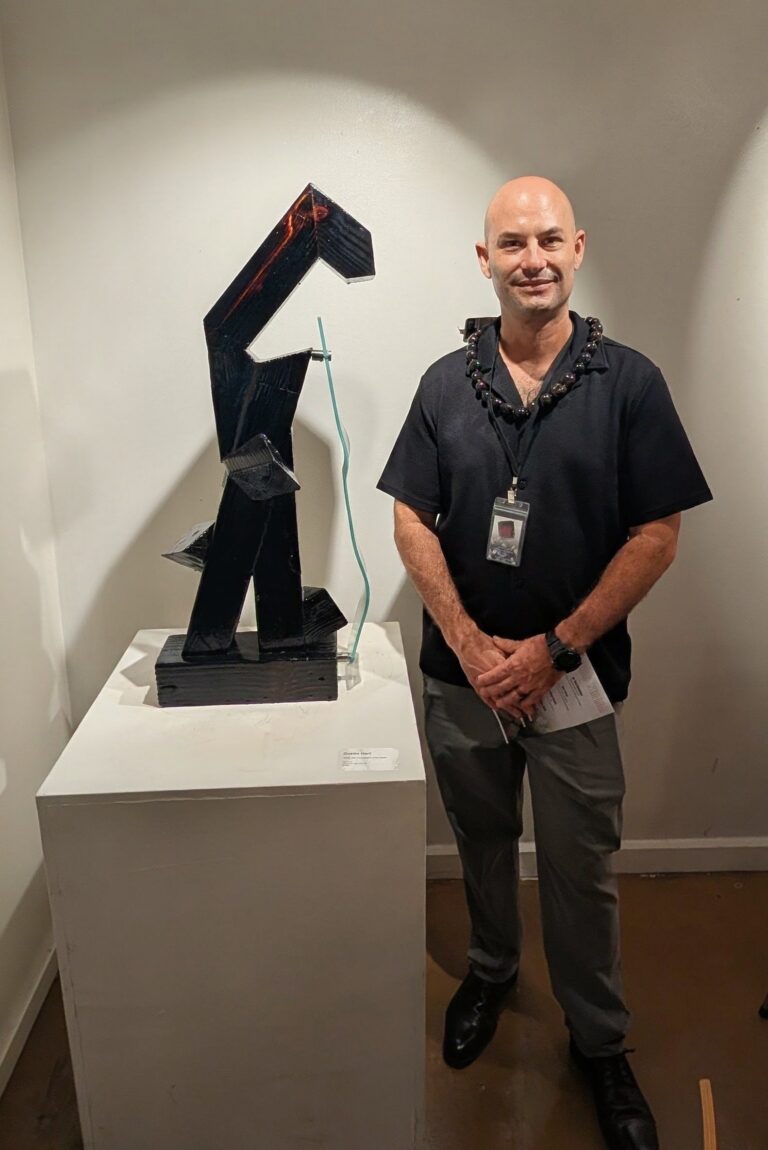
I work with a wide range of materials—glass, ceramics, metals, plastic, wood, stone, and sand—each chosen for what it can reveal or imply in a given moment. Material is not an accessory but a protagonist with its own history, gravity, and symbolic potential. Glass can be luminous, fragile, and transparent, yet capable of structural force and refracted meaning. Ceramics speaks of craft, touch, and ritual, with a language of warmth and restraint. Metals carry weight, memory, and the patina of time. Plastic introduces elasticity, immediacy, and modernity. Wood communicates growth, process, and the timbered memory of forests; it also bears a domestic, elemental presence. Stone embodies endurance, inertia, and lineage. Sand suggests flux, erasure, and the making of newness from granular time. Each material contributes a different visual weight and a distinct psychological aperture through which viewers may engage the work. Among these, I choose burning wood as a deliberate act—an intentional ritual that marks a space as sacred. Burning wood leaves a residue, ash, and scent that imply memory, transformation, and a consecrated moment. By contrast, sand or polishing, while rich with their own aesthetics, do not enact the same ritual claim to the sacred I seek. The burn becomes a quiet vow: to honor the material’s life, and to set apart that moment as a space where viewers might sense the sacred in the ordinary.

Because I was educated primarily in ceramics and glass, craft remains a central thread in my practice. Craft, to me, is not a relic of the past but a living discipline that honors process, technique, and material truth. I am drawn to craft’s insistence on making, its patient pacing, and its respect for material behavior. This grounding shapes how I approach sculpture: I seek to reveal materiality with honesty, to let the inherent qualities of the medium speak through form, and to acknowledge the labor and skill embedded in every surface, joint, and contour. I want viewers to sense the dignity of material—its weight, its response to light, its reflective or absorptive character—so that the object becomes a conscious partner in perception rather than a mere decoration. When I burn wood as part of a piece, the act becomes another layer of craft—an index of time, intention, and the sacred—the visible trace of a decision to honor the material’s most demanding life cycle.

Embracing the Authentic

At the core of Hart’s artistic philosophy is an exploration of impermanence. His sculptures challenge the modern obsession with perfection, emphasizing that beauty and value are found in the transient, imperfect, and aged. By creating environments that encourage stillness and reflection, Hart seeks to deepen the viewer’s awareness of life’s fleeting nature and the importance of authenticity in both art and human experience.

His work invites individuals to pause, to listen, and to reflect on the sacredness of space—whether sacred in the spiritual, cultural, or environmental sense. Through this, Hart fosters an aesthetic and philosophical dialogue about mindfulness, resilience, and the significance of slowing down in a fast-paced world.

Hart’s commitment to these principles extends beyond his studio, informing his pedagogical approach. He encourages students to embrace experimentation, resilience, and imperfections, emphasizing that meaningful growth often arises from slowing down and accepting the natural flow of life and art. His work exemplifies a deliberate rejection of distraction, aiming to cultivate a deeper, more mindful engagement with both material and environment.

Dustin Hart’s sculptures serve as both aesthetic objects and spiritual catalysts, embodying a philosophy that values impermanence, authenticity, and mindfulness. By integrating imperfection, transience, and technology-free spaces, Hart challenges contemporary audiences to reconsider their relationship with art, space, and time. His work exemplifies a vital movement toward slowing down and honoring the sacred in everyday life, offering moments of silence amid a noisy world and inspiring a renewed appreciation for the fleeting beauty of existence.